World Chess Championship 2026: Gukesh vs Sindarov Live Results and Schedule
The World Chess Championship 2026 is a 14-game match between defending champion Gukesh D of India and challenger Javokhir Sindarov of Uzbekistan. It's being played in Geneva, Switzerland, with Game 1 on Tuesday, 24 November 2026 at 7:30 PM IST. The first player to 7.5 points is world champion.
Score: Gukesh 1.5, Sindarov 1.5 after three draws. Game 4 is on Saturday, 28 November at 7:30 PM IST, with Gukesh playing White.
Two years ago nobody would have predicted this: the champion is the underdog. Sindarov arrives rated 72 points higher than Gukesh and ranked 22 places above him. He has also never lost to Gukesh in a classical game. So is Gukesh finished? Not even close (and we'll explain why below). If you read our Candidates 2026 preview, you already know how Sindarov got here. This page picks up the story in Geneva and gets updated after every game, with the result, the opening, and one lesson your child can take to their own board.
World Chess Championship 2026 at a Glance
Detail | Information |
|---|---|
Official name | Salesforce FIDE World Championship Match 2026 |
Defending champion | Gukesh D (India), rated 2710, world No. 26 |
Challenger | Javokhir Sindarov (Uzbekistan), rated 2782, world No. 4 |
Venue | Fondation Martin Bodmer, Cologny, Geneva, Switzerland |
Dates | Opening ceremony 22 November; games 24 November to 11 December; tiebreaks 12 December |
Format | Up to 14 classical games, first to 7.5 points wins |
Start time | 7:30 PM IST (15:00 CET) |
Prize fund | USD 2.5 million |
White in Game 1 | Sindarov |
Official commentators | GM Peter Leko and GM Peter Svidler |
Ratings are from the November 2026 FIDE list (Chess.com). Venue, dates and format are from FIDE.
Gukesh vs Sindarov Live Score and Results
Match score: Gukesh 1.5, Sindarov 1.5 (7.5 points needed to win)
We update this table within two hours of every game. The Opening column tells you what was played on the board. Click through to our opening guides if your child wants to try it.
Game | Date | White | Black | Opening | Moves | Result | Score after game |
|---|---|---|---|---|---|---|---|
1 | Tue 24 Nov | Sindarov | Gukesh | Ruy Lopez, Berlin Defence | 38 | Draw | 0.5-0.5 |
2 | Wed 25 Nov | Gukesh | Sindarov | London System | 20 | Draw | 1-1 |
3 | Thu 26 Nov | Sindarov | Gukesh | Ruy Lopez, Berlin Defence (Rio de Janeiro Variation) | 60 | Draw | 1.5-1.5 |
4 | Sat 28 Nov | ||||||
5 | Sun 29 Nov | ||||||
6 | Mon 30 Nov | ||||||
7 | Wed 2 Dec | ||||||
8 | Thu 3 Dec | ||||||
9 | Fri 4 Dec | ||||||
10 | Sun 6 Dec | ||||||
11 | Mon 7 Dec | ||||||
12 | Tue 8 Dec | ||||||
13 | Thu 10 Dec | ||||||
14 | Fri 11 Dec | ||||||
Tiebreaks | Sat 12 Dec |
Colours alternate from game to game. The match stops as soon as either player reaches 7.5 points, so the later rows may never be played.
Latest: Game 1 Report, Gukesh Holds Sindarov to a Draw):
Latest: Game 3 Report, Gukesh Surprises Sindarov in a 60-Move Draw
Game 3 was the best game of the match so far, and it still ended in a draw. Sindarov opened with 1.e4 again, and Gukesh went back to the Berlin Defence. Then came the surprise: 5...Be7, the Rio de Janeiro Variation, instead of the 5...Nd6 he played in Game 1.
It worked. Gukesh played his first 15 moves in just over two minutes. Sindarov needed 58 minutes to reach the same point. For the first time in the match, the challenger was the one fighting the clock, and he made his 40th move with six seconds to spare.
But Sindarov held on. The game reached an endgame with opposite-coloured bishops (each side has one bishop, on different coloured squares), which is very hard to win, and it was drawn after 60 moves.
Earlier games
Game 2: London System, draw in 20 moves. With White for the first time, Gukesh chose the London System. Sindarov was ready: 7...Qb6 was part of his preparation. Gukesh fell about 40 minutes behind on the clock, and with nothing to play for, he repeated moves. The game was drawn by threefold repetition after 20 moves.
Game 1: Berlin Defence, draw in 38 moves. Sindarov opened with 1.e4 and Gukesh answered with the Berlin. Gukesh was 50 minutes behind on the clock after 17 moves, and Sindarov attacked on the kingside. But Gukesh kept control with 27...Kf6, a move Sindarov admitted he had underestimated. The game ended in a repetition. Both players scored around 99% accuracy.
Three things to watch :
- Sindarov's first move. His team will have spent months on this. A surprise opening on move one would tell you how confident they feel.
- Gukesh's nerves. He's the champion, but he's also coming off a difficult year. At a media event on Sunday he called Sindarov a "genius" (NewsDrum). That's respect, not fear. We'll see which one shows on the board.
- The clock around move 30. With 120 minutes for the first 40 moves, whoever spends too long early can end up rushing in the most complicated part of the game.
Their last classical game came at Tata Steel in January 2026. Gukesh sacrificed his queen and almost won, but Sindarov saved it with a series of checks that the king couldn't escape (ChessBase India). Expect the same fight tonight.
What Time Does the World Chess Championship 2026 Start in India?
Every game starts at 7:30 PM IST, which is 15:00 in Geneva. That's a perfect slot for Indian families: after school and homework, before dinner. Games can run five or six hours, though, so the finish may come after midnight.
Country / city | Local start time | Time zone |
|---|---|---|
India | 7:30 PM | IST (UTC+5:30) |
UAE (Dubai) | 6:00 PM | GST (UTC+4) |
Qatar | 5:00 PM | AST (UTC+3) |
Switzerland (Geneva) | 3:00 PM | CET (UTC+1) |
United Kingdom | 2:00 PM | GMT (UTC+0) |
USA and Canada, East Coast | 9:00 AM | ET (UTC-5) |
USA, West Coast | 6:00 AM | PT (UTC-8) |
Singapore and Malaysia | 10:00 PM | SGT/MYT (UTC+8) |
Australia (Sydney) | 1:00 AM, next day | AEDT (UTC+11) |
No daylight-saving changes happen in any of these places between 24 November and 12 December, so these times hold for the whole match.
World Chess Championship 2026 Full Schedule
The match runs from 22 November to 12 December 2026, with a rest day after every three games.
Date | Day | Event |
|---|---|---|
22 Nov | Sunday | Opening ceremony and colour draw |
24 Nov | Tuesday | Game 1 |
25 Nov | Wednesday | Game 2 |
26 Nov | Thursday | Game 3 |
27 Nov | Friday | Rest day |
28 Nov | Saturday | Game 4 |
29 Nov | Sunday | Game 5 |
30 Nov | Monday | Game 6 |
1 Dec | Tuesday | Rest day |
2 Dec | Wednesday | Game 7 |
3 Dec | Thursday | Game 8 |
4 Dec | Friday | Game 9 |
5 Dec | Saturday | Rest day |
6 Dec | Sunday | Game 10 |
7 Dec | Monday | Game 11 |
8 Dec | Tuesday | Game 12 |
9 Dec | Wednesday | Rest day |
10 Dec | Thursday | Game 13 |
11 Dec | Friday | Game 14 |
12 Dec | Saturday | Tiebreaks (if needed) and closing ceremony |
Seen different dates elsewhere? You're not imagining it. When Geneva was announced in July, FIDE said 25 November to 15 December (FIDE). The final regulations moved it earlier, and the dates above are the official ones (FIDE). Plenty of older articles still show the old dates, so double-check before you plan a watch party.
How Does the World Chess Championship Match Work?
Think of it as a cricket Test series rather than a T20 game. Two players, up to 14 long games, and the first to 7.5 points wins. A win is worth 1 point, a draw half a point, and a loss nothing.
Time control (how much time each player gets)
Each player gets 120 minutes for their first 40 moves, then another 30 minutes for the rest of the game. From move 41, every move also adds 30 seconds to their clock (FIDE). So a single game can last more than five hours.
No quick draws before move 40
Our favourite rule for young players: the two players can't simply agree to a draw before Black's 40th move. A draw that early is only allowed through the arbiter, for a threefold repetition (the same position appearing three times) or a stalemate (a player has no legal move but isn't in check). What it means in practice: no handshake draws after 15 moves. They have to play.
What happens if it's 7-7?
If the score is tied after 14 games, the title is decided on 12 December with faster games:
- Four rapid games at 15 minutes each, plus 10 seconds per move
- If still tied, two games at 10 minutes plus 5 seconds
- If still tied, two blitz games at 3 minutes plus 2 seconds
- If still tied, single 3+2 games, swapping colours each time, until someone wins
And that would be a cruel way to lose a world title. But it's also very exciting to watch.
Want your child to understand games like these, move by move? Kingdom of Chess runs live interactive chess classes for kids with FIDE-certified coaches. Book a free trial class and see what your child picks up in one session.
World Chess Championship 2026 Prize Money
The total prize fund is USD 2.5 million (about ₹21 crore), net of local taxes. Each player earns USD 200,000 for every game they win, and whatever is left is split equally between them (FIDE).
Here's the neat part, which most articles skip. Because of that formula, the winner's prize depends on how many more games they won than their opponent, not on the final score. Each extra game of margin moves USD 100,000 from one player to the other.
How the match ends | Winner gets | Runner-up gets |
|---|---|---|
Winner is one game ahead (for example 7.5-6.5 with one decisive game) | USD 1.35 million | USD 1.15 million |
Winner is three games ahead (for example 7.5-4.5 after Game 12) | USD 1.55 million | USD 0.95 million |
7.5-6.5 with 13 decisive games, or 8-6 with all 14 decisive | USD 1.3 million | USD 1.2 million |
Decided in tiebreaks | USD 1.3 million | USD 1.2 million |
The last two rows are special cases in FIDE's rules: with that many wins, USD 200,000 per win would add up to more than the USD 2.5 million fund. The rupee figure is approximate and moves with the exchange rate.
Who Is Gukesh D?
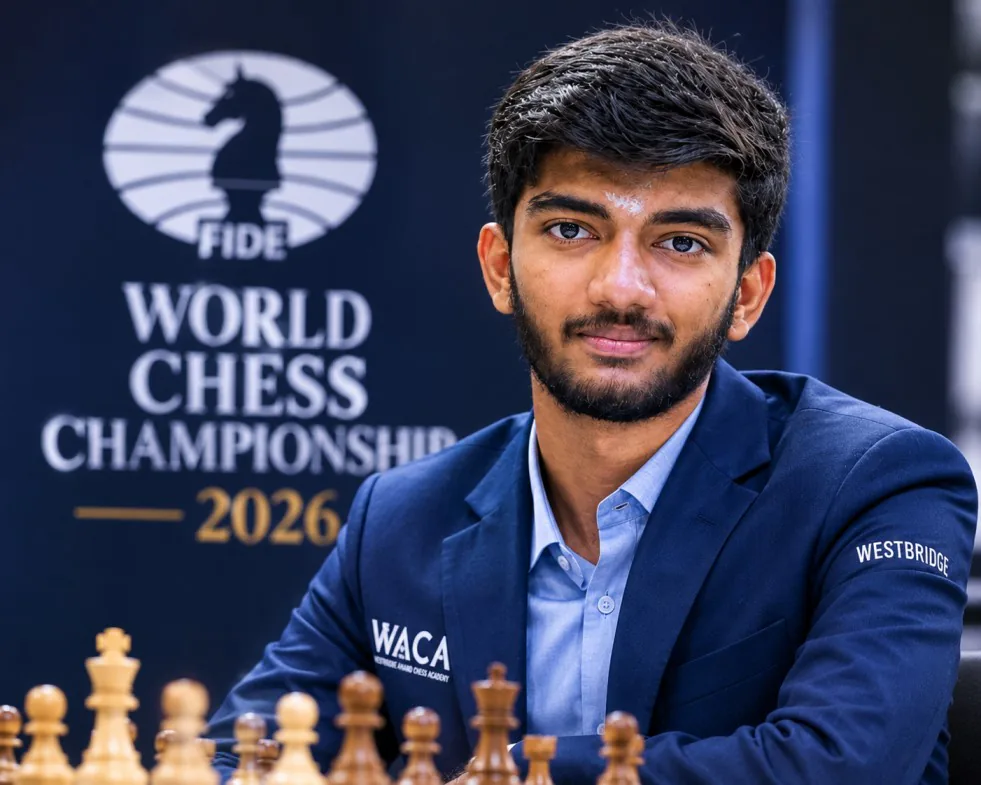
Gukesh Dommaraju is India's reigning world champion, born on 29 May 2006 in Chennai. He won the 2024 Candidates in Toronto at 17. Then, in December 2024, he beat Ding Liren 7.5-6.5 in Singapore and became the youngest undisputed world champion ever, at 18, breaking Garry Kasparov's record (365Chess). He's the 18th world champion and now joins the list of the greatest chess players in history.
His rating has dropped to 2710 since then. But a world title match is a different sport from a rating list, and Gukesh has already won one.
Who Is Javokhir Sindarov?
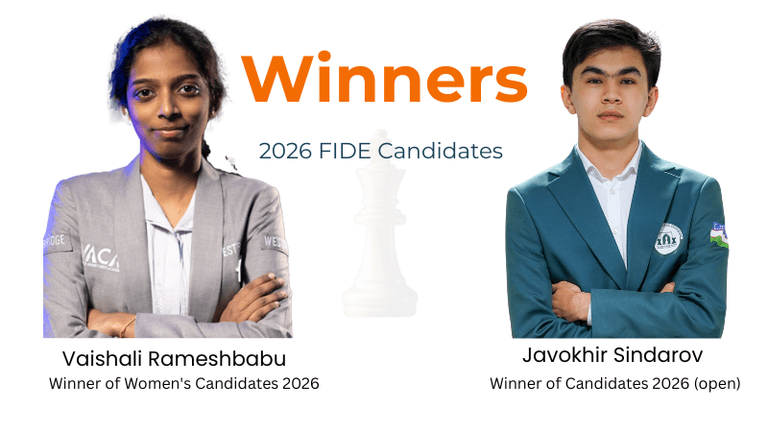
Javokhir Sindarov is a 20-year-old grandmaster from Uzbekistan and the hottest player of the last 12 months. He won the 2025 FIDE World Cup in Goa, then won the 2026 Candidates in Cyprus with 10/14, no losses and a round to spare (FIDE). He's the first Uzbek player ever to qualify for an undisputed world title match, and he's now world No. 4.
One fun detail: Sindarov turns 21 on 8 December, the day of Game 12.
Gukesh vs Sindarov Head-to-Head Record
They've known each other's games since they were kids. In classical chess, Sindarov leads 2-0 with one draw.
Year | Event | White | Black | Result |
|---|---|---|---|---|
2026 | Tata Steel Masters, Wijk aan Zee | Sindarov | Gukesh | Draw |
2022 | Sharjah Masters | Sindarov | Gukesh | Sindarov won |
2018 | Moscow Open | Gukesh | Sindarov | Sindarov won |
Source: 365Chess. In the 2018 game, Gukesh was 11 and Sindarov 12.
And Gukesh has a recent win of his own. In May 2026, right after the Candidates, he beat Sindarov with the black pieces in a rapid game in Warsaw (Onmanorama). Rapid isn't classical, but it was the first time they'd met as champion and challenger.
Who Is the Favourite: Gukesh or Sindarov?
On paper, Sindarov. He's 72 rating points higher, he hasn't lost a classical game to Gukesh, and both Magnus Carlsen and Ian Nepomniachtchi have backed the challenger (WorldChess).
But we've seen this film before, with the roles reversed. In 2024, Gukesh was the in-form, higher-rated challenger and Ding Liren was a champion in a slump. Most people expected a one-sided match. It went all the way to Game 14.
Our view? Sindarov is a slight favourite, and we wouldn't be shocked by either result. Ratings measure how you play across hundreds of games against everyone. A title match is 14 games against one person who has studied you for seven months. Gukesh has already been through that pressure once, and Sindarov hasn't.
Why Is This World Chess Championship Historic?
- The youngest title match ever. Both players are 20, younger than any pair in history (FIDE).
- The first between two players born in the 21st century (365Chess).
- The first Uzbek challenger. Sindarov is the first player from Uzbekistan to qualify for an undisputed title match.
- Back in Switzerland after 22 years. The last title match there was Kramnik vs Leko in Brissago in 2004. Peter Leko, who played that match, is one of this year's official commentators.
- A new national rivalry. India took double gold at the 2024 Olympiad, and Uzbekistan won the 2026 Olympiad in Samarkand (Kursiv). This match is India vs Uzbekistan at the very top.
How to Watch Gukesh vs Sindarov Live
The official broadcast comes from FIDE, with GM Peter Leko and GM Peter Svidler explaining every move (ChessBase). Watching with your child? Pick the commentary over the bare board. Hearing two grandmasters argue about a move teaches more than any engine bar.
- Official stream: FIDE's YouTube channel and the championship website []
- Commentary in Hindi or other Indian languages: []
- Live board with moves only: []
Tip for parents: keep a physical board next to the screen. When the commentators stop on a position, set it up and ask your child, "What would you play here?" Then see what Gukesh or Sindarov actually did.
What Young Players Can Learn From This Match
Kids learn the most from the moments that go wrong, not from the brilliant moves. Here's what we'll be pointing out to our own students over the next three weeks.
- Play the whole game. World champions aren't allowed to agree a draw before move 40. Your child shouldn't offer one after 12 moves either.
- Know why your opening works. Both players will arrive with months of preparation, but the one who understands the ideas behind their moves (not just the moves) handles surprises better. Our guide to chess opening principles is a good place to start.
- Your clock is a piece too. Watch how the players budget their 120 minutes. Rushing in a hard position loses games at every level, from under-9 tournaments to Geneva.
- Losses happen. What you do next matters more. Look at how each player plays the game after a defeat. That's the real test of a champion.
- Respect your opponent. Gukesh called his rival a genius two days before the match. Then he sat down to beat him.
Lesson from each game
- Game 1: Falling behind on the clock isn't a disaster if the time goes into the critical moment. Gukesh spent his minutes around move 15 and found the right defensive setup.
- Game 2: A draw with White isn't a failure. When your opponent has prepared well and the position offers nothing, don't force it. Save your energy for the next game.
- Game 3: Surprise is a weapon. One unexpected move cost Sindarov almost an hour of thinking time. Young players can do this too: learn two different replies to your favourite opening.
Train Like a World Championship Player
Gukesh and Sindarov both started out as kids learning the rules from a coach. Kingdom of Chess began the same way in 2018: Arena Grandmaster Chandrajeet Rajawat teaching four or five students in a small room in Udaipur. Today we teach 10,000+ students in 30+ countries through a structured curriculum, from Pawn (beginner) to Knight, Rook and our King level for tournament players.
If your child is already playing tournaments, our elite chess classes for competitive players cover opening preparation, time management and game analysis like the work you'll see in Geneva. New to chess? Start with a free trial of our online chess classes.
Frequently Asked Questions
Defending champion Gukesh D of India plays challenger Javokhir Sindarov of Uzbekistan. Sindarov qualified by winning the 2026 FIDE Candidates Tournament in Cyprus.
Game 1 is on Tuesday, 24 November 2026. The last scheduled game is on 11 December, with tiebreaks on 12 December if the match is tied 7-7.
Every game starts at 7:30 PM IST (15:00 in Geneva). Games can last five hours or more.
At the Fondation Martin Bodmer in Cologny, near Geneva, Switzerland. It's the first world title match in Switzerland since 2004.
The total fund is USD 2.5 million. Each win earns USD 200,000 and the rest is split equally, so the winner usually takes about USD 1.3 to 1.55 million.
Up to 14 classical games. The first player to 7.5 points wins, so the match can end early.
Javokhir Sindarov has White in Game 1. Gukesh has White in Game 2.