

The chess world is in constant motion. Ratings shift, champions rise, and new talents challenge the established hierarchy. If you’re wondering who the best chess players in the world are right now, the answer demands more than just a single number. It requires understanding current rankings, peak performances across formats, and the context behind each player’s dominance.
This guide breaks down the current world no 1 chess player, the top 10 elite performers, and what makes each one exceptional. Whether you’re a coach seeking inspiration, a student chasing a role model, or a chess enthusiast curious about the modern game, this ranking will clarify who’s leading the world chess elite in 2026.
Who Is the World No 1 Chess Player Right Now?
Magnus Carlsen of Norway holds the #1 FIDE classical rating (2840+), making him the current world no 1 chess player by rating. As of June 2026, no other player has surpassed his rating in classical chess, the format that determines official world ranking. Carlsen’s consistency across rapid and blitz formats, combined with his historical peak rating of 2882 (achieved in 2014), reinforces his case as the strongest player competing today.
Carlsen’s dominance, however, extends beyond raw rating. He holds world titles in multiple time formats, maintains elite performance in classical tournaments, and continues to redefine what it means to “convert” positions into wins. His ability to find small advantages in balanced positions and slowly improve them into decisive victories remains unmatched by contemporaries.
Why These Rankings Matter
Ranking the best chess players in the world is inherently complex. Classical rating captures peak play in long-form chess. Rapid and blitz ratings reflect performance under time pressure. Tournament wins demonstrate practical strength over a field of elite opponents. And historical context reveals who dominated their era most convincingly.
This article prioritizes current FIDE classical ratings (the official world ranking system) but also considers:
- Dominance index: How far ahead is this player from their next competitor?
- Format versatility: Do they excel only in classical, or across rapid/blitz too?
- Tournament wins: Recent victories against world-class fields
- Peak performance: Personal best rating ever achieved
- Influence on the game: How their style shapes modern chess theory
The Top 10 Best Chess Players in the World (2026)
1. Magnus Carlsen (Norway) , Rating: 2840
Title: World No 1, 5x World Champion (2013, 2014, 2016, 2018, 2021)
Peak Rating: 2882 (May 2014)
Claim to Fame: Most consistent elite player of the modern era; world champion for over a decade
Magnus Carlsen’s reign at the top is the longest in modern chess history. After winning the world title in 2013 at age 22, he defended it successfully for eight years. His resignation from classical world championship matches (starting 2022) surprised many, but his dominance in rapid and blitz competitions (World Rapid and Blitz Champion in 2025) proves he remains chess’s most complete player.

Carlsen’s style is methodical. He plays a repertoire designed to avoid early tactical fireworks, preferring positions where his calculation, patience, and endgame technique shine. In balanced positions, where most grandmasters see draws, Carlsen finds imperceptible advantages. His conversion rate in slightly better positions is statistically unsurpassed.
What young players can learn: Carlsen proves that preparation, psychological control, and incremental improvement compound into dominance. His games are studied less for brilliant sacrifices than for precision in technical positions.
2. Hikaru Nakamura (USA) , Rating: 2807
Title: 5x U.S. Chess Champion; World Rapid Champion (2023)
Peak Rating: 2816 (January 2016)
Claim to Fame: The bridge between classical chess and mainstream entertainment
Hikaru Nakamura is chess’s most recognizable face in the digital age. His Twitch streaming has introduced millions to the game. But his rating (second only to Carlsen) and tournament results prove his elite status is not just media savvy.
Nakamura’s strength lies in rapid and blitz formats, where his creative attacking style and quick calculations dominate. In 2023, he won the World Rapid Championship, cementing his case as the world’s second-best player. His classical rating, while formidable, trails Carlsen, suggesting that the time pressure in rapid formats suits Nakamura’s aggressive imagination better than the lengthy preparation required in classical chess.
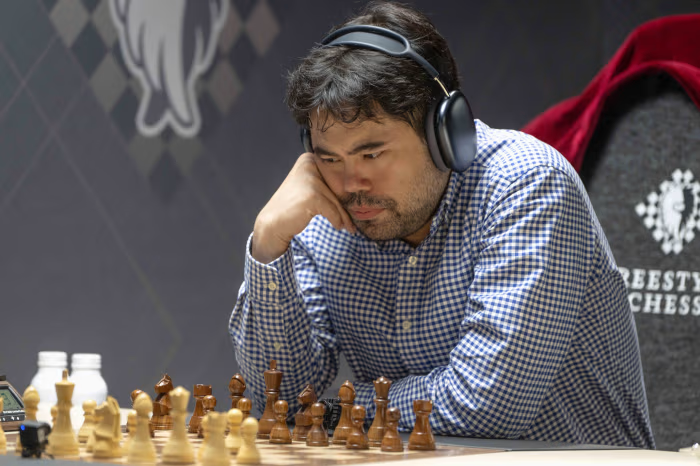
His influence extends beyond tournaments. By streaming, creating content, and competing publicly, Nakamura has made chess accessible to younger generations who might never have encountered the game otherwise.
What young players can learn: Nakamura shows that diversity in chess (classical, rapid, blitz, streaming) is not a distraction but an asset. Excellence in one format often elevates your overall understanding of the game.
3. Fabiano Caruana (USA) , Rating: 2788
Title: World Championship Challenger (2018); 2-time FIDE Grand Prix Winner
Peak Rating: 2822 (May 2014)
Claim to Fame: The most technically perfect player of this generation
Fabiano Caruana represents the pinnacle of classical chess technique. Trained in Italy and competing for the USA, Caruana combines deep opening preparation, flawless middlegame calculation, and fortress-like defense. His 2018 World Championship match against Magnus Carlsen saw 10 consecutive draws, a testament to the defensive perfection that opponents face.
Caruana’s peak rating (2822) places him among the elite, but his classical results are even more impressive. He has won multiple super-tournaments (tournaments featuring exclusively top-20 players) against the world’s best fields. His games are models of coherent chess: clear plans, accurate calculation, and no wasted moves.

The challenge for Caruana: converting his technical mastery into world championship success. His candidate appearance (2018, 2022) shows sustained excellence, but finishing the final step requires something beyond pure technique , a psychological edge that Carlsen possesses naturally.
What young players can learn: Caruana’s games are ideal for students aged intermediate and above. He demonstrates how to outprepare opponents in openings and methodically improve throughout the middlegame without relying on tactics alone.
4. Nodirbek Abdusattorov (Uzbekistan) , Rating: 2780
Title: World Rapid Champion (2021); 44th Chess Olympiad Gold (First Board, 2022)
Peak Rating: 2785 (April 2024)
Claim to Fame: The youngest to win World Rapid Championship at age 17; rising superpower
Nodirbek Abdusattorov represents the next generation of super-talents. At 17, he became the youngest player ever to win the World Rapid Championship, a title previously held by legends. His rating, now in the 2780s, shows no sign of stopping as he matures.
Abdusattorov’s rise from Uzbekistan is part of a broader pattern: chess talent is increasingly distributed globally. Training facilities, online resources, and engines have democratized access to chess knowledge. Abdusattorov benefits from this, competing at world level while still in his teens.

His playing style is dynamic and sharp. He combines solid positional understanding with aggressive tactical play, making him dangerous in all formats. In rapid chess, where intuition and calculation speed matter most, his youth is an advantage: younger brains process information faster under pressure.
What young players can learn: Abdusattorov’s trajectory shows that elite chess is no longer dominated by a single country or training method. Hard work, engine study, and online competition can create world-class players from any background.
5. Javokhir Sindarov (Uzbekistan) , Rating: 2776
Title: Young Star; Rising Candidate
Peak Rating: 2776 (March 2026)
Claim to Fame: Uzbekistan’s dual super-talents alongside Abdusattorov
Javokhir Sindarov is climbing rapidly. His rating places him squarely in the world’s elite top 5, and his recent performances suggest he’s not done climbing. Like Abdusattorov, Sindarov benefits from Uzbekistan’s resurgence as a chess powerhouse.
What distinguishes Sindarov is his classical chess strength. While Abdusattorov excels in rapid formats, Sindarov has shown the ability to compete in slow classical games against the world’s elite. His peak rating (2776) is notably high for a player still in his early 20s, suggesting his growth trajectory will continue.

Sindarov’s games show solid classical preparation, practical middlegame play, and the mental stamina to compete in long matches. He is less flashy than Nakamura or Abdusattorov but potentially more dangerous in the format that defines world championships.
What young players can learn: Sindarov proves that sustainable growth requires balance: build opening knowledge, practice tactical sharpness, and develop endgame technique. He’s a model of the “complete” player.
6. Anish Giri (Netherlands) , Rating: 2767
Title: 4x Dutch National Champion; World Championship Candidate (2022)
Peak Rating: 2802 (February 2015)
Claim to Fame: Cerebral positional player; feared opponent in classical chess
Anish Giri is the thinking player’s favorite. His games feature nuanced positional ideas, prophylactic thinking (preventing opponent ideas before they’re announced), and deep strategy. He rarely blows games against lower-rated opponents, and against equals, his preparation is legendary.
Giri’s rating (2767) understates his classical strength. In World Championship candidate tournaments, he consistently places near the top despite rating deficits to frontrunners. His defensive technique allows him to hold seemingly lost positions, frustrating opponents who expect to convert advantages.

The knock against Giri: he has not converted his classical strength into a world championship challenge. His candidate appearances did not yield the aggressive, winning performances needed to progress to the finals. This gap between rating and results highlights the psychological component of elite chess, a lesson for students of the game.
What young players can learn: Giri’s games teach patience, planning, and prophylactic calculation. His approach is ideal for students who think slowly but deeply, showing that there’s no single “correct” path to mastery.
7. Alireza Firouzja (France) , Rating: 2759
Title: World Championship Candidate (2022); 2x Iranian National Champion
Peak Rating: 2777 (July 2024)
Claim to Fame: Prodigy who switched federations; the future of world chess
Alireza Firouzja, now representing France after emigrating from Iran, is chess’s most talented rising star. At 22, he already competes at super-GM level and has secured candidate tournament spots. His combination of preparation depth, tactical sharpness, and psychological maturity suggests he could challenge for the world title within 5-10 years.
Firouzja’s playing style blends the best of several traditions: solid positional foundations, sharp tactical eye, and aggressive piece play. He avoids boring positions, preferring complications where his calculation advantages shine. Against weaker opposition, he can rack up wins. Against equals, he contests every position fiercely.

His journey (Iran to France) mirrors chess’s global evolution. Talent is no longer bound by geography or tradition. A young player from any country, given resources and motivation, can reach the world’s elite.
What young players can learn: Firouzja’s aggressive approach to chess shows that playing with fighting spirit and sharp positions is a valid path to mastery, not a detour from “proper” technique.
8. Ding Liren (China) , Rating: 2754
Title: 17th FIDE World Champion (2023-2024)
Peak Rating: 2816 (March 2016)
Claim to Fame: Represents the rise of chess in China; peak classical world champion
Ding Liren briefly held the world championship title after defeating GM Ian Nepomniachtchi in 2023. Though he subsequently lost the title to D. Gukesh in December 2024, his classical strength and championship reign underscore China’s emergence as a chess superpower.
Ding’s style is pragmatic and flexible. He combines solid preparation with practical problem-solving. Against objectively superior opponents, he plays for specific results, not abstract perfection. This mentality, playing the opponent, not the board, has served him well in match situations where psychology matters as much as calculation.

At 31, Ding is in the prime of his career. His classical rating (2754) suggests he remains in world title contention, though the rise of younger players (Gukesh, Firouzja) means the title picture is increasingly competitive.
What young players can learn: Ding’s championship victory proved that classical strength and tournament success can still capture the world title. Against the narrative that rapid/blitz dominates, Ding showed the enduring value of deep preparation and classical chess mastery.
9. Viswanathan Anand (India) , Rating: ~2765 (ratings fluctuate)
Title: 15th Undisputed World Champion (2007-2013); 5x World Rapid Champion
Peak Rating: 2817 (May 2010)
Claim to Fame: Greatest Indian player of all time; the “Renaissance Man” of chess
Viswanathan Anand holds a unique place in modern chess history. His world championship reign lasted six years (2007-2013), during which he defended his title three times. He has won the World Rapid Championship five times, more than any other player. His playing repertoire spans aggressive attacks to fortress defenses.
At 56 (born 1969), Anand no longer competes in classical world championship races. However, his peak rating (2817) places him among the all-time greats, and his classical dominance in the 2000s-2010s is beyond dispute.

Anand’s influence transcends rankings. As an Indian grandmaster who reached the world’s apex, he inspired an entire generation of Indian players (Praggnanandhaa, Nihal Sarin, Arjun Erigaisi) to pursue elite chess. His mentorship and example continue to shape the game’s future.
What young players can learn: Anand’s career demonstrates the value of versatility across time formats. His ability to excel in rapid chess alongside classical competitions shows that mastering multiple speeds deepens your understanding of all formats.
10. Rameshbabu Praggnanandhaa (India) , Rating: 2748
Title: World Championship Challenger (2024); Youngest World Championship Finalist Ever
Peak Rating: 2748+ (June 2026)
Claim to Fame: Teenaged phenom; the future of world chess
Rameshbabu Praggnanandhaa burst onto the world stage as a teenager with extraordinary results. At 18, he qualified for the World Championship match (2024), becoming one of the youngest finalists ever. His classical rating (2748) at such a young age signals a trajectory that could place him in the world’s top 3-5 within a decade.
Praggnanandhaa’s playing style is dynamic and aggressive. He combines solid positional understanding with sharp tactical play and psychological confidence beyond his years. Against world champions and top grandmasters, he doesn’t play to avoid losses; he plays to win.
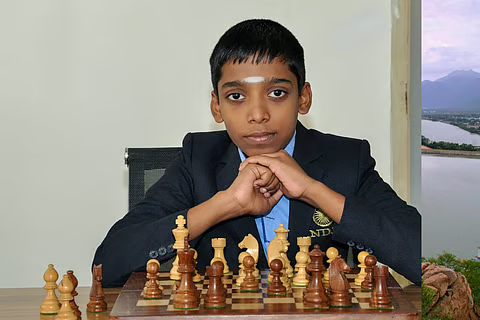
His rise is emblematic of modern chess: young players have access to chess engines, databases, and online training that took older generations years to build. Praggnanandhaa trained largely with engines and online resources, proving that traditional coaching is no longer a prerequisite for reaching the elite.
What young players can learn: Praggnanandhaa demonstrates that age is not a barrier to elite chess. Young players with determination, strong foundational knowledge, and access to modern tools can compete with and defeat the world’s best.
How Are Chess Players Ranked?
The FIDE Elo rating system is the official measure of chess strength. Players gain or lose rating points based on tournament results against rated opponents. A win against a higher-rated player yields more points; a loss to a lower-rated player costs more points.
The classical rating is considered the “true” ranking because it reflects strength in long-form chess with extensive time (typically 90 minutes or more per side for moves 1-40). Rapid and blitz ratings measure strength under time pressure but are secondary to classical rankings in determining official world standing.
Current rating thresholds (as of 2026):
- 2800+: Super-elite (Carlsen, Nakamura, Caruana)
- 2750-2799: Elite top-10 players
- 2700-2749: Grandmaster elite (frequent World Championship candidates)
- 2600-2699: Strong grandmasters
- 2500-2599: International masters and strong grandmasters
The rating gap between positions matters. A 20-point difference is significant; a 50-point difference is nearly insurmountable. Carlsen’s 33-point lead over Nakamura (2840 vs 2807) represents a meaningful concrete advantage.
The Debate: Who Is the Greatest Chess Player of All Time?
Current best in the world ≠ greatest of all time. These are separate questions with different answers.
Carlsen holds the highest peak rating ever (2882), suggesting strongest absolute playing strength when accounting for modern preparation. But historical greats like Kasparov, Fischer, and Karpov played under different conditions.
The consensus: Kasparov is typically named the greatest (20+ years as world no 1; dominated rivals at historically extreme margins). Carlsen is “the strongest player ever yet,” given his peak rating. Fischer’s dominance in 1971-72 (Elo advantage: 200+ points over nearest rival) remains historically unmatched in relative terms.
This debate enriches chess culture and gives young players role models across eras. There’s no single correct answer, and that’s part of chess’s beauty.
Key Insights from the 2026 Top 10
- Youth is rising: Abdusattorov, Sindarov, Firouzja, and Praggnanandhaa (ages 19-22) are in the world’s top 10. The rate of talent emergence accelerates yearly.
- Dominance is no longer assured: Carlsen’s rating lead (33 points over Nakamura) is smaller than Kasparov’s historical dominance. Competition among the elite is fiercer than ever.
- Uzbekistan is a new superpower: Two players in the top 5 hail from Uzbekistan, representing a global shift in chess training and talent distribution.
- Classical chess still matters: Despite rapid/blitz’s popularity, world championship matches still use classical time controls. Ding’s championship reign and Praggnanandhaa’s finalist appearance affirm classical chess’s enduring prestige.
- Diversity within excellence: Playing styles range from Carlsen’s methodical technique to Nakamura’s aggressive creativity to Giri’s prophylactic thinking. There’s no single path to mastery.
Frequently Asked Questions
Magnus Carlsen of Norway is the best chess player in the world as of 2026, holding the #1 FIDE classical rating of 2840. No other active player has surpassed his rating in official classical chess, the format that determines world ranking. Carlsen's consistency across rapid and blitz formats, combined with his historical peak rating of 2882, reinforces his dominance as the world's strongest player.
The top 10 best chess players in the world (2026) by FIDE classical rating are: 1) Magnus Carlsen (2840), 2) Hikaru Nakamura (2807), 3) Fabiano Caruana (2788), 4) Nodirbek Abdusattorov (2780), 5) Javokhir Sindarov (2776), 6) Anish Giri (2767), 7) Alireza Firouzja (2759), 8) Ding Liren (2754), 9) Viswanathan Anand (~2765), and 10) Rameshbabu Praggnanandhaa (2748). These rankings are based on official FIDE ratings updated monthly.
Gukesh of India won the 2024 World Chess Championship, defeating Ding Liren to become the 18th undisputed world champion at age 18, making him the youngest world champion in history. While Gukesh holds the championship title, Magnus Carlsen maintains the higher FIDE classical rating (2840 vs. Gukesh's ~2740), illustrating the distinction between rating (strength measurement) and title (match victory).
Chess players are ranked using the FIDE Elo rating system, where players gain or lose points based on tournament results against rated opponents. A win against a higher-rated player yields more points; a loss to a lower-rated player costs more points. Classical rating (90+ minutes per side) determines official FIDE world ranking, while rapid and blitz ratings measure performance under time pressure but are secondary to classical rankings for determining world standing.
The greatest chess player of all time depends on how you measure greatness. Garry Kasparov is typically named the greatest (20+ years as world no 1, historically extreme dominance over rivals). Magnus Carlsen is "the strongest player ever" by peak rating (2882, highest ever achieved). Bobby Fischer's 1971-72 dominance (200+ point rating advantage over rivals) remains historically unmatched in relative terms. The debate enriches chess culture because different eras, playing styles, and criteria yield different answers.
Yes, modern talent rises faster than ever. Rameshbabu Praggnanandhaa reached the World Championship match at age 18. Nodirbek Abdusattorov reached the top 5 by age 19. With access to chess engines, databases, and online training, elite players can compress decades of knowledge into years. However, converting training progress into world-level results under pressure still requires experience and psychological maturity that cannot be fully replaced by preparation alone.
The Path Forward
Chess’s world rankings are dynamic. Praggnanandhaa’s trajectory could carry him into the top 5 within two years. A breakout performance by Firouzja in classical tournaments could push him toward 2800. Conversely, injuries, psychological setbacks, or shifting preparation strategies could affect any player’s rating.
The world’s best chess players represent the pinnacle of human calculation, pattern recognition, and competitive psychology. Studying their games, understanding their preparation methods, and following their tournament progress offers lessons that extend far beyond the 64 squares.
If you’re inspired by the world’s elite and considering a chess journey of your own, Kingdom of Chess offers structured coaching from FIDE-certified grandmasters who have trained dozens of competitive players. Our curriculum is designed to build the foundational skills, tactical sharpness, and tournament experience needed to compete at higher levels.
The next world champion might be learning from our coaches right now. Could it be you?
Also Read


