
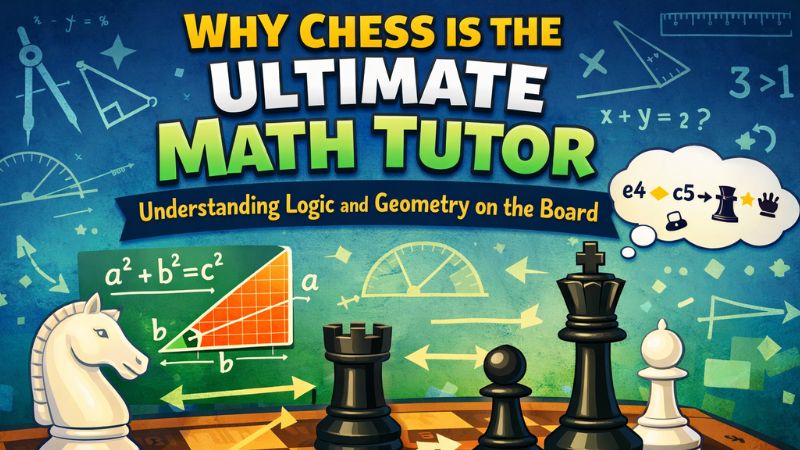
Why Chess is the Ultimate Math Tutor: Understanding Logic and Geometry on the Board
Parents often come to me with a variation of the exact same confusing story. Just last month, a mother told me her nine-year-old son, Leo, had been in tears at the kitchen table over his fraction homework. He complained that math was “too hard,” “boring,” and that he just couldn’t see the point of it. Yet, barely two hours later, this very same kid was hunched over a chessboard in my online coaching class, perfectly still, calculating a complicated three-move sequence to trap his opponent’s knight.
When his plan failed and he lost the game, he didn’t cry. He just reset the pieces and spent another twenty minutes trying to figure out a different angle.
Something interesting happens when kids start learning chess. They don’t realize it, but they’re actually doing complex math on almost every single move. As a coach, I see this silent translation happen all the time. Kids who struggle to sit still for a black-and-white math worksheet will happily navigate the complex, invisible geometry of a chessboard for hours. It’s one of the best-kept secrets in education: chess is the ultimate disguised math tutor.
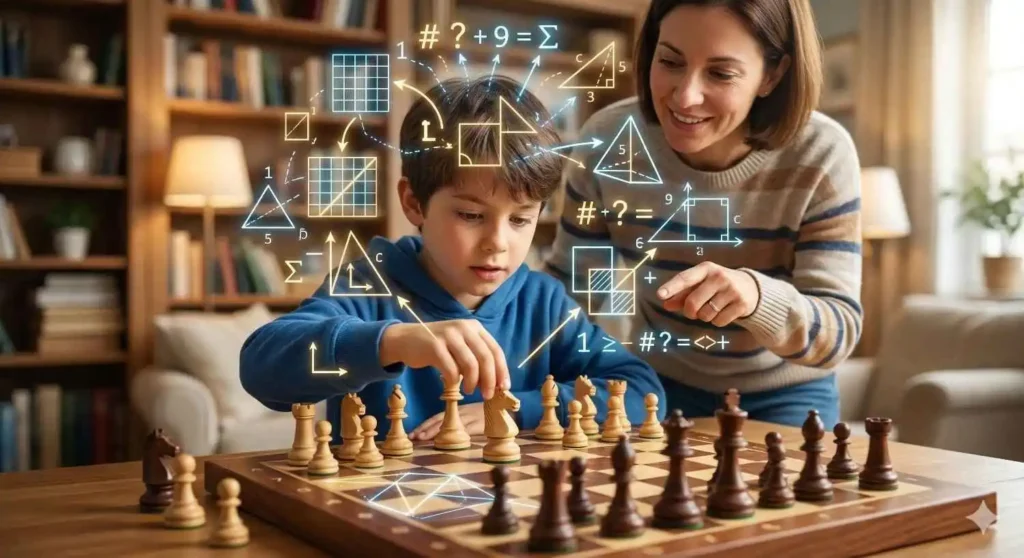
More Than Just a Game: Why Chess is "Secret Math"
When a child sits down at a chessboard, they aren’t thinking about complex equations or variables. In their heads, they are busy launching daring attacks, defending their king, and trying to outsmart the person sitting across from them. It’s an exciting battle of wits!
However, beneath those wooden pieces and the ticking clock, chess is a purely mathematical universe. While your child is playing, they are actually practicing high-level logic and arithmetic without even realizing they are “learning.”
Calculating the Next Move
Both math and chess require a child to step through a problem logically. In a math classroom, a student solves an equation by anticipating how moving a number changes the outcome. In chess, we call this calculation.
Before a child even touches a piece, they learn to ask themselves: “If I move here, what happens next?” This process helps them develop essential thinking skills, such as:
Logic and Reasoning: Understanding cause and effect.
Visualization: Holding “shifting variables” and future board positions in their mind.
Abstract Problem-Solving: Finding solutions to challenges that haven’t happened yet.
Mental Arithmetic on the Fly
Every piece on the board has a specific numerical value. As children play, they constantly use these numbers to decide if a move is a good idea. To help them keep track, we assign points to the pieces:
Pawn: 1 point
Knight or Bishop: 3 points
Rook: 5 points
Queen: 9 points
Every time a child considers trading their knight for an opponent’s bishop and a pawn, they are performing instant mental arithmetic. They are calculating if the trade is “profitable” or if it will leave them at a disadvantage.
The best part? They are mastering basic math operations and strategic thinking without the usual anxiety that comes with a timed classroom test. It makes math feel like a tool for victory rather than a chore.
The Hidden Geometry of the Chessboard
The board itself is essentially a giant piece of graph paper. It’s an 8×8 grid where every single square has a specific coordinate, like “e4” or “c5”. But what really transforms a child’s spatial awareness is how the different pieces are allowed to move through this grid.
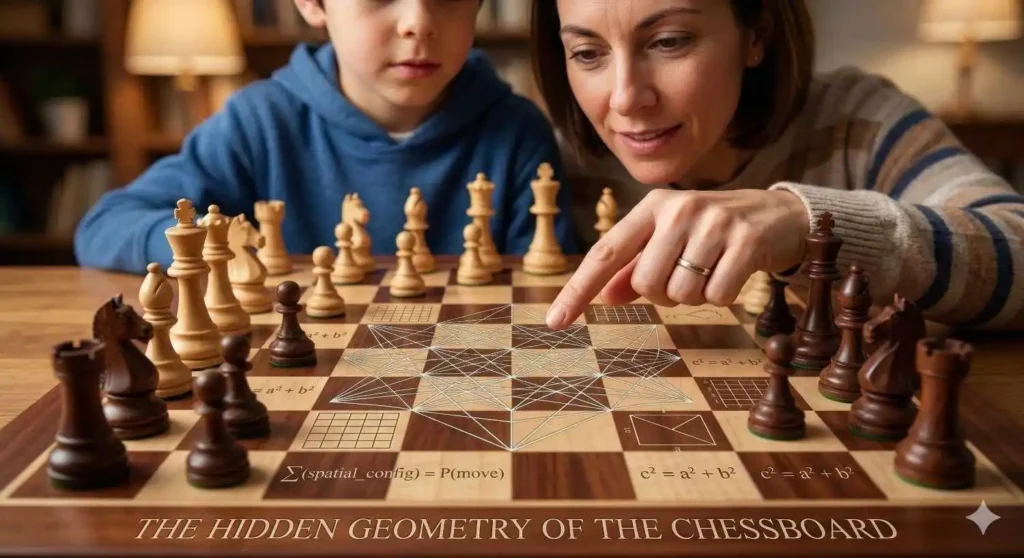
Here is how the pieces secretly teach geometry:
- Bishops and Diagonal Intersections: Kids often struggle conceptually with diagonal lines and intersecting angles on paper. But give them a bishop, a piece that can only slide diagonally and is bound to a single color for the entire game, and suddenly they understand how to project a line across a plane. They learn to visualize invisible intersecting paths and figure out where two lines will cross.
- Knights and Spatial Rotation: The knight is notoriously the trickiest piece for beginners because it doesn’t move in a straight line. It moves in an “L” shape—two squares in one direction, and one square to the side—and it’s the only piece that can jump over obstacles. Teaching a child to visualize where a knight will land forces their brain to perform complex spatial rotations.
- Rooks and Grid Distance: Rooks move in straight horizontal or vertical lines. This introduces kids to what mathematicians call “taxicab” or “Manhattan” geometry. Instead of measuring distance in a straight diagonal line (like a bird flying), they have to calculate distance by following the rigid lines of a grid, just like a taxi navigating through city blocks.
How Chess Builds Logical Thinking Step by Step
Math isn’t just about memorizing times tables; at its core, it is about logic. When a student learns algebra or writes geometry proofs later in high school, they have to start with a known fact and logically deduce the next necessary step. Chess builds this exact mental muscle from the time a child is five years old.
Just like mathematicians form complex proofs from basic axioms, chess players build broad strategies from the simple movement rules of the pieces.
- If-Then Reasoning: A child quickly learns that impulsive moves lead to disaster. They start thinking conditionally: “If I push my pawn, then her bishop will attack my rook.” This “if-then” framework is the absolute foundation of algebraic thinking and computer programming.
- Pattern Recognition: Mathematicians identify patterns in numbers and equations. Similarly, chess players memorize geometric patterns on the board—like a ‘fork’ (attacking two pieces at once) or a ‘pin’—allowing them to recognize similarities between a game they are playing today and a puzzle they solved last week.
- Deductive Reasoning: Just like ruling out incorrect answers on a multiple-choice test, a chess player has to look at four or five possible candidate moves, mentally test the outcome of each one, and deduce which option is the safest and most effective.
Why Children Who Play Chess Often Improve in Math
It is completely natural to wonder if moving little wooden horses around a board can actually help your child get better grades. While it might look like “just a game,” the results consistently show up on report cards. I’ve heard from countless parents who were shocked to see their child’s math grade jump a full letter grade after just a few months of chess practice.
This isn’t just a coincidence—it’s backed by science. Research shows that chess training directly improves the specific mental “muscles” kids need to succeed in the classroom. When children play regularly, they develop critical thinking skills that serve as the foundation for advanced learning.
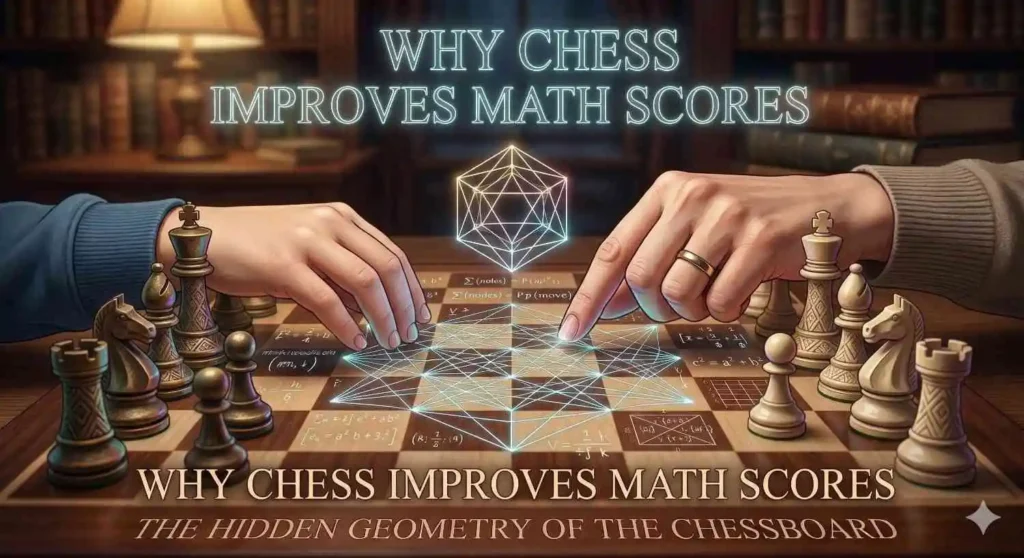
How Chess Builds "Math Brains"
Chess acts like a gym for the mind. By navigating the challenges of a match, children naturally sharpen several key skills that translate directly to their math homework:
Spatial Reasoning: Understanding how objects move and relate to one another in space.
Strategic Planning: Learning to think several steps ahead to reach a goal.
Logical Decision-Making: Weighing different options and choosing the best path forward.
Pattern Recognition: Identifying familiar shapes and sequences, which is the heart of algebra.
Building Resilience Through Play
One of the biggest hurdles in math isn’t just the numbers; it’s the frustration that comes with a hard problem. When a child sits down for a 30-minute chess game, they are actively stretching their attention span and learning how to handle “the struggle.”
Chess teaches children the rare art of sitting with a difficult problem. Instead of giving up when the board looks confusing, they learn to work through the chaos one step at a time. This emotional resilience is a game-changer for schoolwork.
Staying Focused: Training the brain to ignore distractions for longer periods.
Solving Complex Problems: Breaking down a big “scary” problem into smaller, manageable moves.
Confidence in Confusion: Learning that being “stuck” isn’t a reason to quit—it’s just a puzzle waiting for a solution.
By the time they face a page of intimidating math word problems, they’ve already practiced the exact same mental process over a chessboard. They realize that math isn’t something to fear; it’s just another game they know how to play.
Practical Ways Parents Can Use Chess for Learning
You definitely don’t need to be a chess master to help your child extract these educational benefits. If you want to encourage logical thinking at home, here are a few highly practical ways you can use the game to support your child’s learning:
- Count the Material Value: When practicing at home, occasionally pause the game and ask your child to add up the value of the pieces they’ve captured versus the pieces they’ve lost. Since queens are 9, rooks are 5, bishops/knights are 3, and pawns are 1, it’s a brilliant way for younger kids to practice mental addition and subtraction.
- Play “Knight’s Tour” Minigames: If your child is struggling with spatial awareness, clear the entire board and place only a white knight on it. Ask them to jump the knight to a specific target square in the fewest moves possible. It feels like a fun video game challenge, but it’s pure geometry training.
- Ask “What was your plan?”: When they make a move during a casual game, gently stop them and ask, “What was your idea behind that move?” Forcing them to articulate their logical reasoning out loud solidifies their if-then thinking.
- Use Board Coordinates: Encourage them to call out their moves using the board’s grid (like saying “Knight to f3”). This seamlessly introduces them to how X and Y coordinate planes work, making future middle-school graphing assignments feel completely familiar.
Why Chess Is More Than Just a Game
I always tell parents that as coaches, we aren’t just teaching kids how to checkmate a king; we are teaching them how to process information. The chessboard is a safe, low-stakes laboratory where children can test hypotheses, make mistakes, and learn from them instantly without a bad grade attached to the outcome. It takes the abstract, sometimes intimidating concepts of math and geometry and turns them into something tangible that they can actually hold in their hands and control.
As we look toward the future of education, finding activities that build cognitive resilience, focus, and genuine problem-solving skills is more critical than ever. Chess doesn’t just improve math scores in the short term; it builds a mental foundation for patient, logical thinking that applies to every single academic subject.
This is exactly why, as we discuss in our main guide, Chess for Child Development: The Best Extracurricular Activity in 2026, this ancient game remains one of the most powerful and engaging tools for preparing your child’s mind for the challenges of tomorrow.
Frequently Asked Questions (FAQs)
Chess helps children develop logical thinking, pattern recognition, and problem-solving abilities. When kids calculate moves, evaluate positions, and predict outcomes, they practice the same analytical skills used in mathematics. These mental exercises make it easier for children to understand mathematical concepts over time.
Yes, chess is one of the best activities for developing logical reasoning. Each move requires a child to think about cause and effect, plan strategies, and analyze multiple possibilities. This structured thinking naturally strengthens logic skills that are useful in both math and everyday decision-making.
The chessboard itself is a geometric grid made of ranks, files, and diagonals. Pieces like bishops move diagonally, rooks move in straight lines, and knights move in unique L-shaped patterns. Through gameplay, children unconsciously learn spatial relationships, angles, and board geometry.
Children can begin learning basic chess concepts as early as 5 years old. At this age, chess can significantly support brain development, focus, memory, and early logical reasoning skills when taught in a fun and structured way.
Kingdom of Chess provides structured chess coaching designed specifically for children. Their programs focus on improving logical thinking, problem-solving skills, and overall cognitive development while keeping the learning process engaging and fun.