
When parents compare chess academies, the real question is not:
“Which one is popular?”
The real question is:
Which system will build my child properly over the next 3–5 years?
Two well-known structured academies in India are:
Both focus on training young players.
Both offer structured online programs.
But their training philosophy and depth of system differ.
Let’s break this down carefully.
Training Philosophy
Eight Times Eight

Eight Times Eight follows a structured competitive model.
The focus is:
- Teaching concepts
- Practicing regularly
- Improving performance
- Preparing for tournaments
The system is designed to help students steadily improve through guided sessions and competitive exposure.
This works well for students who:
- Learn by repetition and practice
- Thrive in structured group environments
Want steady competitive growth
Kingdom of Chess
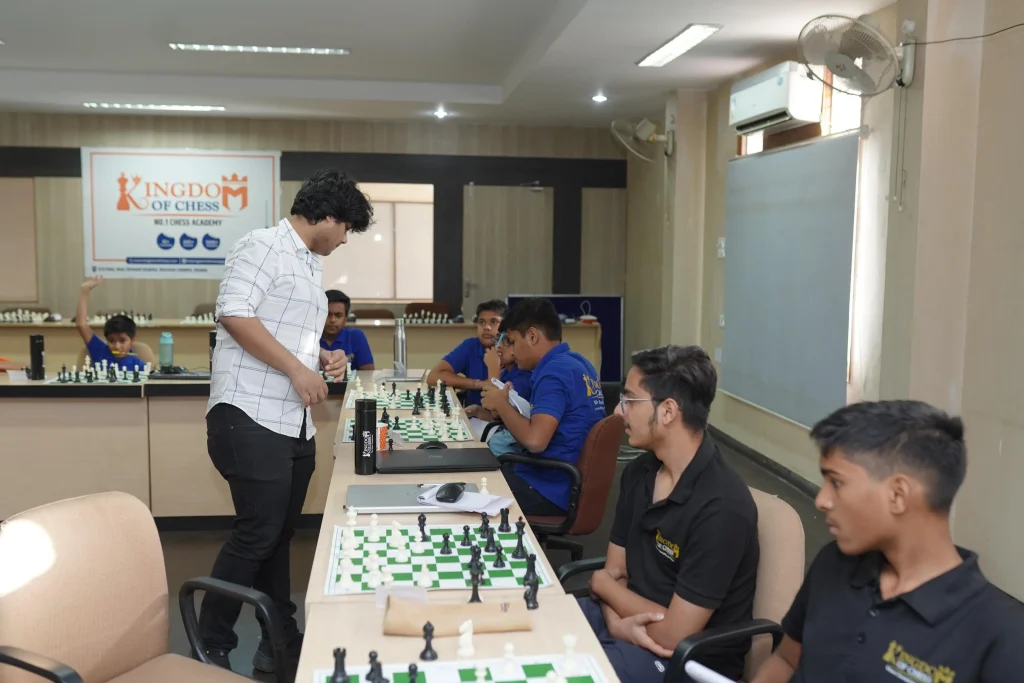
Kingdom of Chess is built more like an academic institution.
Instead of just grouping students broadly, the academy divides learning into:
- 3 Major Levels (Beginner, Intermediate, Advanced)
- Multiple Sublevels within each stage
That means a child does not just “move up” randomly.
They move only after mastering:
- Tactical foundations
- Opening understanding
- Endgame principles
- Positional concepts
- Tournament mindset
This creates a layered development model.
It feels closer to a school curriculum than a coaching batch.
For parents who want structured long-term mapping, this adds clarity.
Student Progression System
This is where differences become more visible.
Eight Times Eight
- Structured batches
- Performance-based improvements
- Competitive focus
Progression is visible through performance and tournament participation.
Kingdom of Chess
- Defined milestones
- Sublevel assessments
- Clear measurable advancement stages
Instead of “improving generally,” students complete defined learning blocks before moving ahead.
That reduces gaps in foundation.
If long-term rating growth matters, foundation strength becomes critical.
Coaching Structure
Both academies employ trained coaches.
However, Kingdom of Chess places strong emphasis on:
- FIDE-rated coaches
- Structured training methodology
- Curriculum adherence
That reduces variability between batches.
Consistency matters when scaling education.
If one batch is strong and another is weak, long-term development suffers.
Tournament Ecosystem
Both academies prepare students for tournaments.
The difference lies in systemization.
Eight Times Eight:
- Encourages competitive participation
- Builds tournament exposure
Kingdom of Chess:
- Integrates tournament preparation into curriculum stages
- Focuses on tactical drilling
- Emphasizes rating improvement structure
One focuses on exposure.
The other integrates competition into development design.

Long-Term Development (The 3-Year View)
This is the question most parents forget to ask:
“What happens after year one?”
Eight Times Eight works well for steady competitive improvement.
Kingdom of Chess appears slightly stronger in:
- Structured multi-year planning
- Defined skill roadmap
- Measurable stage transitions
For serious players aiming at district, state, or national levels, this structural depth can make a difference.
Direct Comparison Table
| Parameter | Eight Times Eight | Kingdom of Chess |
|---|---|---|
| Training Model | Structured competitive coaching | Curriculum-driven structured development |
| Levels | Batch-based grouping | 3 Levels × Multiple Sublevels |
| Progress Tracking | Performance & exposure based | Milestone & mastery based |
| Coaching | Trained coaches | FIDE-rated & structured training adherence |
| Tournament Prep | Competitive exposure focus | Integrated tournament-building system |
| Long-Term Planning | Competitive progression | Multi-year mapped roadmap |
| Parent Clarity | Regular communication | Structured milestone transparency |
Which Type of Child Fits Each System?
Eight Times Eight may suit:
- Children who improve through practice and exposure
- Students comfortable in structured group coaching
- Families looking for competitive momentum
Kingdom of Chess may suit:
- Analytical learners
- Parents who want defined progression clarity
- Students targeting long-term rating growth
- Families thinking 3–5 years ahead
Final Words
Both academies are serious and structured.
The difference is not about quality.
It is about system depth.
Eight Times Eight offers structured competitive training.
Kingdom of Chess builds a layered curriculum-based chess journey with defined milestones, which may provide slightly stronger structural clarity for long-term competitive growth.
For casual improvement, both work.
For roadmap-driven development, Kingdom of Chess feels more academically designed.