
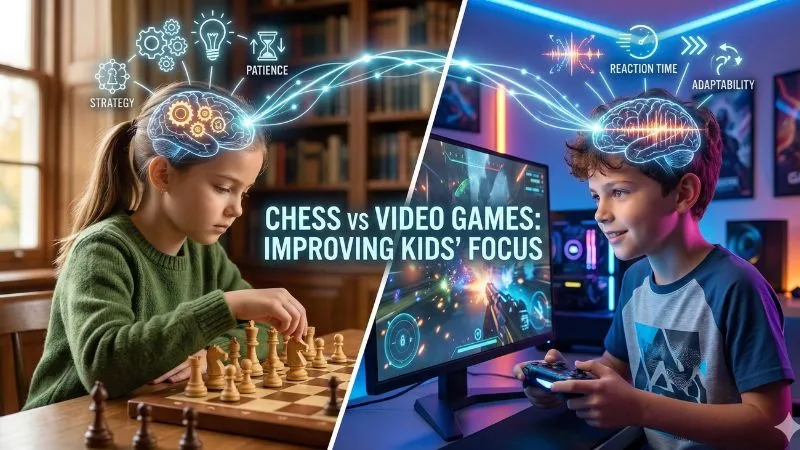
Chess vs. Video Games: How 64 Squares Rebuild Your Child's Attention Span
The Modern Paradox of Pediatric Attention
Parents frequently ask a bewildering question regarding modern child development: why can a child play fast-paced video games for two uninterrupted hours, yet struggle profoundly to focus on a simple homework assignment for ten minutes? This paradox is a common source of frustration and anxiety in contemporary households. One father recently shared a story that perfectly encapsulates this dilemma. His eight-year-old son would attempt to complete a standard jigsaw puzzle or a math worksheet, only to become visibly frustrated, fidgety, and ultimately quit within moments. Yet, when handed a tablet to play a fast-paced mobile game, the same child would remain glued to the screen, his attention unwavering, entirely oblivious to the world around him.
Caregivers observe these specific, everyday situations with growing concern. Children seem to become overwhelmingly impatient when learning something difficult. They get easily distracted during routine tasks, and there is a noticeable, overarching reduction in baseline attention spans that seems to correlate directly with the presence of digital devices.
Interestingly enough, the solution to this modern digital dilemma might be found in an analog game that has existed for over a millennium. By observing how a child transitions from feeling intensely frustrated after losing a chess game to gradually learning patience, resilience, and deep focus, educators and coaches have identified a powerful tool for cognitive rehabilitation. This comprehensive analysis explores the neurobiological impact of digital media on pediatric attention spans and details exactly how the 64 squares of a chessboard can be utilized to rebuild a child’s focus, step by step.
The Digital Age and the Fragmentation of Focus
It’s a scene every parent knows: your child struggles to sit through ten minutes of math homework, yet they can stay glued to a video game for three hours straight. It’s easy to assume they just aren’t “trying,” but the reality is more complex. It isn’t a lack of attention; it’s a structural shift in how their brains are being wired.
To understand this, we have to look at the two ways the brain pays attention:
Top-Down Attention: This is the “brain muscle” used for homework. It requires internal willpower, focus, and effort to stick with a task that isn’t necessarily “fun.”
Bottom-Up Attention: This is reactive. It’s triggered by loud noises, bright lights, or fast movement. It’s automatic and requires almost no effort at all.
Modern apps and games are meticulously designed to hijack that second type of attention, leaving the “willpower” side of the brain out of practice.
The Antidote: Why Chess Requires Deep Thinking and Patience
In a world filled with flashing screens and instant notifications, many parents are noticing that their children struggle to focus on tasks that don’t provide an immediate “hit” of excitement.
The difference between a fast-paced video game and a game of chess isn’t just about the rules; it’s about how these activities literally rewire your child’s brain. While one encourages a “quick fix” mentality, the other builds the mental stamina required for real-world success.
When a child plays chess, they aren’t just moving wooden pieces; they are training their brain to enjoy the process of solving a problem. The dopamine release they get from a well-calculated move is linked to authentic achievement.
By choosing chess over high-speed digital play, children experience:
A Shift in Preference: Their brains move away from needing instant gratification and toward a tolerance for hard work.
Dopamine Recalibration: The brain’s “wanting” system is calmed, making it easier to focus on “boring” tasks like homework or reading.
Intrinsic Motivation: They learn to feel good about the effort they put in, not just the flashing lights on a screen.
Building a "Stable" Attention Span
Conversely, a chessboard is visually static and structurally bounded. There are no notifications or digital interruptions. The task is strictly limited, which allows the brain to maintain a stable, unbroken level of focus.
Why this “unbroken focus” matters for your child:
Strengthens the Prefrontal Cortex: This is the part of the brain responsible for decision-making and self-control.
Reduces Mental Fatigue: Because the brain isn’t jumping between stimuli, it can think more deeply without getting “fried.”
Complex Thinking: It enhances the ability to hold and manipulate complex ideas in the mind at once.
By encouraging analog activities like chess, you are essentially giving your child the tools to resist the “digital drain” and develop a brain built for sustained, meaningful attention.
Rebuilding Concentration Step by Step
Changing a child’s habits from the “click-and-react” world of digital screens to the deep focus of a chessboard doesn’t happen overnight. It is a gradual process that requires a bit of patience and a lot of guided practice.
When kids first start playing, they often bring their “digital habits” with them. You’ll see them rushing moves and grabbing pieces impulsively. In the world of chess, we call this “tunnel vision”—they are so focused on their own immediate action that they completely miss what the opponent is doing.
The Magic of the "Pause"
After a few weeks of practice, something wonderful happens: the child starts to pause. This tiny moment of hesitation is actually a major neurological milestone. It’s the moment their brain’s “brakes” take over, stopping an impulsive reaction so they can think instead.
This shift is the foundation of rebuilding a broken attention span. By learning to stop and think, children are literally training their brains to override the urge for instant action.
Teaching the "Blunder Check"
To help kids slow down, coaches use a simple but powerful technique called the “blunder check.” Before a child even touches a piece, they are taught to ask themselves a few key questions. This forces the brain to move from “reactive mode” to “analytical mode.”
Common habits parents notice during this rebuilding phase:
Initial Impulsivity: Rushing to capture a piece without looking at the rest of the board.
The “Blunder Check” Habit: Stopping to scan the board for threats before making a move.
Increased Inhibitory Control: The ability to resist making a “fast” move in favor of a “right” move.
Building Mental Stamina for the Real World
Serious chess games can last for a long time, sometimes even hours. This requires immense mental endurance. Just like a muscle, the brain’s ability to focus can be strengthened through this kind of “heavy lifting.”
Key lessons children learn through slow play:
Deconstruction: Breaking down big, scary problems into small, manageable steps.
Patience over “Cheap Tricks”: Realizing that quick fixes (like a “Scholar’s Mate”) don’t work against smart opponents.
Strategic Maneuvering: Learning that building a long-term advantage is better than getting a quick, temporary win.
By encouraging this slow, methodical way of thinking, we are helping our children move away from the “instant fix” culture and toward a future where they have the grit and patience to solve real-world challenges.
The Cognitive Benefits of Chess for Children
The hypothesis that chess strengthens overall cognitive abilities is grounded in substantial empirical research, particularly concerning the development of executive functions. Executive functions are the higher-order cognitive skills that act as the “management system” of the brain, allowing individuals to control behavior, manage emotions, and achieve goals.
Playing chess operates as a mental gymnasium, actively targeting and strengthening several distinct domains of a child’s cognitive architecture.
Memory and Pattern Recognition
Chess is fundamentally a game of recognition and memory. A child must hold the image of the board in their mind, calculate a knight move, envision the opponent’s potential response, and remember the original position if the calculated line fails. This intensely exercises visuospatial working memory. The more games a child plays, the more comfortable and agile their brain becomes in recognizing positions and strategies. Chess creates “meaningful repetition”. Kids see the same patterns many times—such as a back-rank checkmate or a basic tactical fork. Each time they encounter it, their brain stores the information more deeply. Studies at the University of Memphis have demonstrated that playing chess significantly improves children’s attention spans, visual memory, and spatial-reasoning abilities through this mutually reinforcing process.
Complex Problem-Solving
At each juncture during a game, a player has to consider possible replies, evaluate threats, and formulate counter-threats. This process of always being on the lookout for opportunities and pitfalls requires profound cognitive flexibility. When an opponent makes an unexpected defensive move, the child must immediately abandon their planned attack and shift strategies dynamically. This ability to adapt to changing circumstances on the board directly enhances general problem-solving skills. Clinical studies evaluating youth engaged in structured chess programs have indicated a statistically significant positive difference in decision-making and problem-solving metrics after just 14 sessions.
Decision-Making and Accountability
Chess instills a broader prowess to compute logically because it forces a player to work strictly within the parameters and rules of the game. Every move has an objective, immediate consequence. If a child makes a careless move, they lose a piece; there is no random chance or external factor to blame. This perfect accountability teaches children to weigh their options meticulously before acting. Because chess arguments are readily assessed as either working or failing on the board, children learn to back up their decisions with concrete evidence.
The translation of these skills from the chessboard to daily life is profound. The following table illustrates how the executive functions trained during a chess game manifest in practical, everyday situations.
Real Examples of Breakthroughs in Focus
It is one thing to talk about the science of the brain, but it is another to see it in action. Consider the story of an eight-year-old boy diagnosed with ADHD. At first, he couldn’t sit still for more than a few minutes. On the chessboard, he played at a “breakneck” speed, moving pieces almost instantly without a second thought.
To help him, coaches started with small, simple puzzles that forced him to slow down. The real breakthrough, however, didn’t stay on the board—it followed him home to the family living room.
From "Reactive" to "Reflective"
His parents began noticing profound changes in his daily behavior. He started waiting his turn during conversations, staying focused on his homework for much longer, and showing a new level of patience during his chores.
While chess didn’t “cure” his ADHD, it provided a safe, structured environment—a kind of “mental gym”—where he could practice self-regulation. By following the rules of the game, he was actually practicing how to control his impulses in real life.
Common behavioral shifts parents notice:
Improved Turn-Taking: Better social patience and less interrupting.
Homework Endurance: An increased ability to sit through mental tasks without getting up.
Reduced Hyperactivity: A general “calming” effect on physical restlessness.
Thoughtful Reactions: Fewer “knee-jerk” emotional responses to daily frustrations.
The "Moment of the Pause"
In chess academies, we often see students treat the game like a fast-paced video game, rushing through moves just to see what happens. But with consistent coaching, a “breakthrough moment” eventually arrives.
The child reaches a complex position on the board and, instead of grabbing a piece immediately, they physically stop. They look. They calculate. They think. This simple pause is a monumental milestone in a child’s development.
More Than Just a Game
As highlighted in the 2026 guide, “Chess for Child Development: The Best Extracurricular Activity,” these breakthroughs are why educators now see chess as a foundational tool for growth rather than just a competitive sport.
When a child learns to stop and study the board, that habit “spills over” into the rest of their life. They become calmer, sharper, and more attentive to the world around them.
Why the “Chess Pause” matters for life:
Strengthens Self-Control: It builds the “mental brakes” needed to stop impulsive mistakes.
Encourages Strategy: Kids learn to look at the “big picture” before acting.
Builds Confidence: Solving a complex problem through focus feels better than winning by luck.
Practical Tips for Parents: Introducing Chess Without Forcing It
Despite the profound benefits of the game, imposing chess on a child as a mandatory academic chore can easily backfire, resulting in resentment and resistance. If a child perceives chess as a punishment or merely an extension of schoolwork, their affective filter closes, nullifying any potential cognitive benefits. Introducing the game requires a delicate balance, blending playfulness with structured cognitive challenges.
Making the Game Accessible
The most effective way to spark interest is to normalize the game’s presence in the home. Leaving a chessboard set up in a highly visible, easily accessible area—such as the living room coffee table or a dedicated play space—encourages the child to interact with the pieces on their own terms. When the child initiates interest, it is crucial to keep the initial sessions brief. Because modern children often possess shorter attention spans, lessons should be planned accordingly. Practicing for just 15 to 20 minutes at a time maintains excitement and prevents cognitive fatigue.
Furthermore, the emphasis must fundamentally remain on learning and effort rather than winning. Caregivers should praise the child’s focus, the logic behind their moves, and their ability to sit still, reinforcing a growth mindset. Asking open-ended questions during play—such as “What do you think your opponent is trying to do now?” or “Why did you choose that square?”—forces the child to verbalize their spatial reasoning, keeping them engaged without lecturing them.
Utilizing Scaffolded Mini-Games
Introducing a full 64-square board populated with 32 pieces can easily overwhelm a child’s working memory. To systematically build attention and teach piece mechanics in a fun, stress-free manner, experienced coaches rely heavily on “mini-games.” These are isolated, highly focused scenarios with reduced variables that train specific cognitive and tactical skills without the pressure of a full match.
Navigating Emotional Meltdowns and the Psychology of Defeat
For many parents, the hardest part of introducing chess isn’t teaching the rules—it’s handling the “big feelings” that happen when the king gets cornered. Unlike video games, where a loss can be blamed on a “glitch” or a “bad teammate,” chess is a game of total personal accountability.
When a child loses in chess, there are no excuses. This can trigger a “cocktail” of intense emotions like frustration and embarrassment. For a child used to the fast-paced, high-stimulation world of digital games, this sudden hit of reality can feel overwhelming.
Why Chess "Meltdowns" Happen
Because chess is a game of “perfect information”—meaning everything is visible on the board—a loss feels very personal. If your child’s emotional regulation is already strained by too much screen time, their nervous system might go into overdrive.
You might see tears, a flipped board, or a total shutdown. While it looks scary, this is actually a vital “workout” for their emotional resilience. They are learning to process deep disappointment without the distraction of a screen.
Signs your child is struggling with emotional regulation:
Externalizing Blame: Trying to find an excuse for why they lost.
Autonomic Responses: Physical signs of distress like crying, red face, or shaking.
Total Withdrawal: Wanting to quit the game entirely after one bad move.
Impulsive Reactions: Physical outbursts like pushing pieces or the board.
The "Snack and Scan" Strategy
Coaches often advise parents not to rush in with immediate comfort or to feel “guilty” for the child’s tears. Children are remarkably resilient; a child crying over a lost Queen can often be laughing five minutes later if given the space to reset.
The most effective way to move past a loss is what we call the “post-game analysis over a snack.” Food has a way of calming the nervous system and making big problems feel smaller.
How to turn a “loss” into a “lesson”:
Identify Pivot Points: Ask, “Where did our plan change?” instead of “Why did you lose?”
Focus on the Journey: Highlight a great move they made in the middle of the game.
Curiosity Over Shame: Ask questions like, “What did we learn about how powerful that Bishop can be?”
Separate Effort from Outcome: Remind them that one mistake doesn’t erase all the smart thinking they did before it.
Building "Profound Resilience"
By shifting the focus from the final checkmate to the moves that came before it, you are teaching your child a life-changing skill: Intellectual Curiosity. They learn that a single blunder doesn’t define them. This process builds the psychological grit they need to face real-world challenges instead of avoiding them. Over time, they stop fearing the “loss” and start looking forward to the “lesson.”
Signs That Chess is Improving a Child's Thinking Ability
As your child continues their “analog journey” on the chessboard, you’ll start to see the magic happen off the board. The brain training they get from chess doesn’t stay at the game table; it begins to show up in how they handle schoolwork, chores, and even tricky social situations.
These small victories are signs that their cognitive “muscles” are getting stronger. You’ll notice they aren’t just playing a game anymore—they are practicing how to handle life with a bit more calm and a lot more thought.
The "Internal Blunder Check"
One of the first things you’ll notice is a physical drop in impulsivity. In the digital world, kids are trained to click first and think later. In chess, that habit leads to losing a Queen. Eventually, the child learns to pause.
This “pause” starts to appear during homework. Instead of scribbling down the first answer that pops into their head, they stop. They are doing an internal “blunder check,” scanning their work for mistakes before they commit to an answer.
Real-world signs of reduced impulsivity:
Thinking Before Speaking: A noticeable beat of silence before they react to a sibling or a tough question.
Stillness During Focus: Adopting a calm, steady posture when trying to remember a math formula or a spelling word.
Double-Checking: Voluntarily looking over a completed task to ensure they didn’t miss anything.
Overcoming the "Starting Struggle"
Does your child struggle to just start their homework? Improved “task initiation” is a major sign that their brain’s CEO—the executive function—is taking charge. Chess teaches kids that a complex board is just a puzzle waiting to be solved, one piece at a time.
Children who used to avoid unfamiliar or difficult tasks begin to show more grit. They have internalized a powerful lesson: initial confusion isn’t a reason to quit; it’s just the starting position of a solvable problem.
Indicators of better executive function:
Willingness to Tackle Multi-step Problems: Not getting overwhelmed by a long list of instructions.
Less Procrastination: Starting assignments without needing five reminders from a parent.
Increased Mental Stamina: Staying with a difficult task for longer periods before asking for help.
From Puzzles to Progress
By practicing on the 64 squares of a chessboard, your child is essentially building a “cognitive scaffolding.” They are learning that slow, methodical work leads to a win. Whether they are figuring out a checkmate
or a long-division problem, they are using the same mental tools of patience and strategy.
A Sanctuary of Focus in a Distracted World
Reflecting on the challenges of raising children in an era defined by continuous digital connectivity, it becomes clear that attention is no longer something that can be taken for granted; it is a skill that must be actively cultivated. The modern environment is relentlessly designed to capture and fragment a child’s focus, offering endless streams of instant gratification that leave young minds easily frustrated and cognitively exhausted.
In this context, the 64 squares of a chessboard offer something entirely unique: a sanctuary of quiet, demanding, and deeply rewarding thought. Chess does not offer flashing lights or immediate neurochemical shortcuts. Instead, it demands that a child sit still, face their mistakes with accountability, and build the internal willpower necessary to solve complex problems over time.
Parents who encourage this journey are doing far more than introducing a hobby. They are helping their children rebuild their attention span, develop patience, and cultivate the kind of resilient thinking that is essential for growing up in a world full of distractions. Through structured learning and thoughtful guidance, Kingdom of Chess aims to support this transformation, helping children become more focused, confident, and thoughtful learners.
Frequently Asked Questions (FAQs)
Chess requires children to think before making every move. They must observe the board, predict their opponent’s actions, and plan strategies. This process trains the brain to stay focused for longer periods, which gradually improves a child’s concentration and attention span.
Not all video games are harmful, but many fast-paced games are designed to give instant rewards and constant stimulation. This can make it harder for children to stay focused on slower activities like studying or problem-solving. Chess, on the other hand, encourages patience and deep thinking.
Chess encourages logical reasoning, planning, and decision-making. Children must evaluate different possibilities before choosing a move. Unlike many video games that rely on quick reactions, chess develops critical thinking and strategic planning.
Children can begin learning chess as early as 5 or 6 years old. At this stage, they are able to understand simple rules and basic strategies. Structured learning programs, like those offered by Kingdom of Chess, help young learners grasp concepts in a fun and engaging way.
Yes. Chess can be a healthy alternative to excessive screen time because it engages children in thoughtful and meaningful play. Even when played online, chess requires focus and problem-solving rather than passive entertainment.