
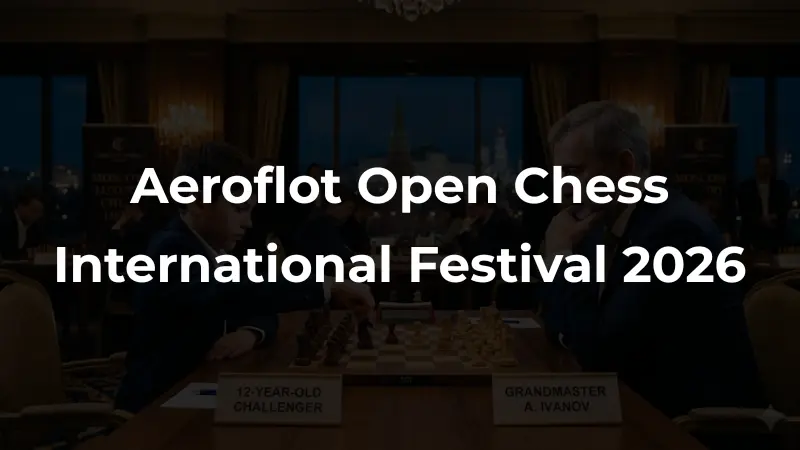
The Aeroflot Open Chess International Festival 2026 is one of the most important events on the global chess calendar. Taking place from February 27 to March 6 at The Carlton Hotel in Moscow, this tournament brings together elite grandmasters and the next generation of chess talent.
For parents and enthusiasts, the 2026 edition is particularly exciting. It features a new time format and a high-stakes quest by a 12-year-old prodigy to break a world record.
Tournament Overview and Format
The 2026 festival is the 21st edition of this prestigious event. It is divided into three main sections to include players of all skill levels and ages.
| Tournament Section | Participants | Requirements |
|---|---|---|
| Tournament A | Professional Players | FIDE Rating 2300 |
| Tournament B | Children | Born in 2014 or later (Under 13) |
| Tournament C | Legends | Invited Veterans |
A major change this year is the introduction of the 60+30 time control. This means each player has 60 minutes for the whole game, with 30 seconds added for every move made. This is the first major international festival to use this “rapid classical” format for official classical ratings, making the games faster and more exciting for spectators.
The Stakes: Prizes and Professional Growth
The festival features a total guaranteed prize fund of 20,000,000 Russian rubles. The first-place winner of Tournament A receives 3,400,000 rubles.
Beyond the money, the tournament is part of the official FIDE Circuit 2026–2027. This means the results help determine who qualifies for the World Championship cycle, adding a level of prestige that attracts the world’s best players.
Key Players to Watch
Ian Nepomniachtchi
The top seed and two-time World Championship challenger, Ian Nepomniachtchi, has shown dominant form. By the end of round eight, he held a sole lead with 7 points out of 8, securing at least a share of first place heading into the final round.
Faustino Oro
The chess world is closely following 12-year-old International Master Faustino Oro from Argentina. Oro is attempting to become the youngest Grandmaster (GM) in history.
To break the record held by Abhimanyu Mishra, Oro must earn his final GM norm by March 11, 2026. In the final round on March 5, he faced a “win-on-demand” situation with the black pieces against Grandmaster Aleksey Grebnev. A win would make him the youngest GM ever, while a draw or loss would leave him just short of the record.
Tournaments Standings
Tournament A
The 2026 edition featured 14 grandmasters rated above 2600, making it one of the densest fields in international chess. Heading into the final day, the competition was fierce, with a total prize fund of 20,000,000 Russian rubles at stake.
| Rank | Player | Points (After R8) | Status |
|---|---|---|---|
| 1 | Ian Nepomniachtchi | 7 | Sole Leader |
| 2 | David Paravyan | 6 | Chasing Group |
| 3 | Arseniy Nesterov | 6 | Chasing Group |
| 4 | Aleksandr Shimanov | 6 | Chasing Group |
| 5 | Mukhammadzokhid Suyarov | 6 | Chasing Group |
Ian Nepomniachtchi, Russia’s highest-ranked active player and a two-time World Championship challenger, has dominated the field. By reclaiming the sole lead after round six and defeating Maksim Chertkov in round eight, he secured at least a share of first place and the 3,400,000 ruble top prize.
The biggest story of the festival was 12-year-old International Master Faustino Oro from Argentina. Nicknamed the “Messi of Chess,” Oro entered the tournament with one goal: to become the youngest Grandmaster (GM) in history.
Heading into the final round on March 5, Oro faced a “moment of truth.” To break the record held by Abhimanyu Mishra, he needed to win his final game with the black pieces against the undefeated 19-year-old Russian Grandmaster Aleksey Grebnev.
Tournament B: Aeroflot Open Children
In the Under-13 open competition, Kirill Zhelonkin from Moscow led the field with 6 points out of 8 heading into the final round. In the girls’ section, Alisa Genrietta Yunker showed incredible dominance, maintaining a perfect score of 7 out of 7 in the early stages and retaining her lead through the home stretch.
Tournament C: The Legends
The Legends section brought together iconic veterans by personal invitation. Rafael Vaganian (Armenia) emerged as the winner, showing that pattern recognition and strategic wisdom are skills that last a lifetime.
Why This Matters for Young Learners
At Kingdom of Chess, we believe tournaments like the Aeroflot Open are perfect examples of how chess builds essential life skills. Watching masters manage time and pressure helps students understand:
- Focus: The 60+30 format requires intense concentration that helps combat digital distractions.
- Emotional Grit: Dealing with a “must-win” game, like Faustino Oro, teaches children how to handle high-pressure situations.
- Planning: Structured online chess classes show results. In our experience, just 4 months of chess can make a child 2x faster at pattern recognition.
Frequently Asked Questions
It is a faster version of classical chess where each player has 60 minutes plus a 30-second bonus per move. As of 2026, FIDE recognizes this for standard ratings.
Official pairings and live games are available on the festival's website (aeroflotopen.ru) and the Chess Federation of Russia portal (ruchess.ru).
Yes, Tournament B is specifically for children under the age of 13.
A GM norm is a high-level performance in a tournament. A player generally needs three norms and a 2500 rating to become a Grandmaster.