

When your child begins learning chess, you’ll hear names like:
- Italian Game
- London System
- Queen’s Gambit
- Sicilian Defence
To most parents, these sound confusing.
But here’s the good news:
You don’t need to know every move from theory.
You just need to understand the style of each opening — because different openings teach your child different thinking skills.
This guide breaks down the most popular openings in simple, parent-friendly language.
No jargon. No overcomplication.
Just clarity.
What Is a Chess Opening (In the Simplest Way)?
A chess opening is the set of first moves that help your child:
- develop pieces
- control the centre
- stay safe
- get a strong position
Different openings teach different styles:
- Some are aggressive
- Some are safe
- Some are slow and strategic
- Some explode into tactics
Choosing the right opening is about choosing the right learning approach for your child.
The 7 Main Opening Styles
Below is the clearest breakdown you’ll find anywhere online — written from a coach’s lens and a parent’s understanding.
The Italian Game — Fast, Open & Tactical

Style: Quick development + early attacks
What kids learn:
- tactical ideas
- aggressive plans
- piece coordination
Why it’s good:
Kids love attacking. Italian gives them confidence early.
Typical moves:
1. e4 e5 2. Nf3 Nc6 3. Bc4
Best for:
Kids who enjoy speed, energy, and tactics.
2) The London System — Easy, Solid & Very Beginner-Friendly
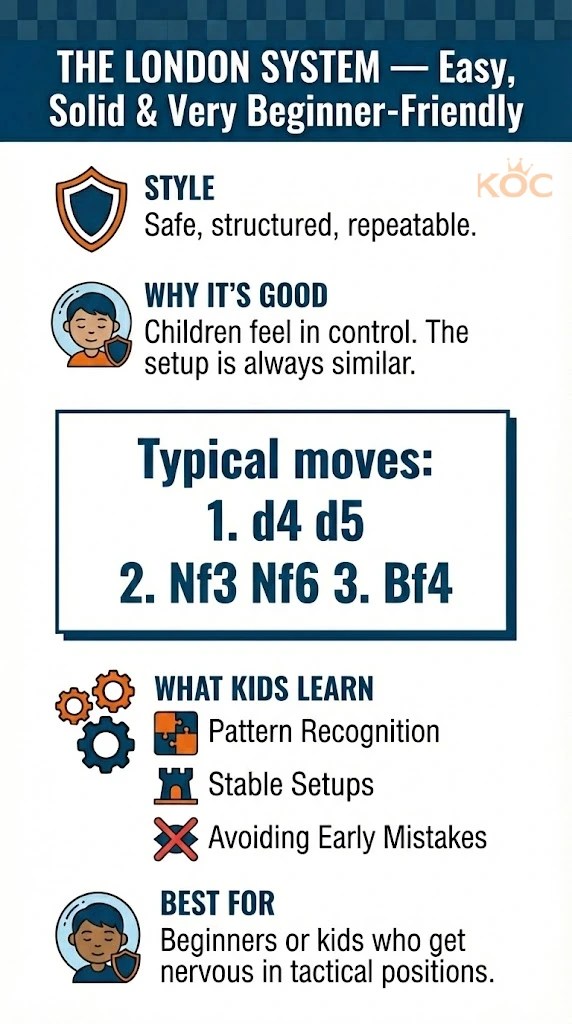
Style: Safe, structured, repeatable
What kids learn:
- pattern recognition
- stable setups
- avoiding early mistakes
Why it’s good:
Children feel in control. The setup is always similar.
Typical moves:
1. d4 d5 2. Bf4 Nf3
Best for:
Beginners or kids who get nervous in tactical positions.
3) The Queen’s Gambit — Strategic & Educational

Style: Spacious, positional, long-term
What kids learn:
- planning
- space control
- pawn structure
Why it’s good:
It builds foundational understanding, not just tricks.
Typical moves:
1. d4 d5 2. c4
Best for:
Kids who enjoy calm, logical play.
4) The Sicilian Defence — Sharp, Advanced & Dynamic

Style: Counter-attacking + very tactical
What kids learn:
- deep calculation
- initiative
- attacking from the black side
Why it’s good:
It teaches how to fight for a win with Black.
Typical moves:
1. e4 c5
Best for:
Intermediate and advanced kids.
5) The French Defence — Closed, Strategic & Patient

Style: Solid centre + long-term plans
What kids learn:
- pawn-chain strategy
- slow building
- defensive skills
Why it’s good:
Teaches patience, timing, and structured thinking.
Typical moves:
1. e4 e6 2. d4 d5
Best for:
Kids who need to slow down and think deeper.
6) The Caro–Kann — Safe, Logical & Reliable

Style: Classical development + low risk
What kids learn:
- clean pawn structures
- logical move order
- strong endgame positions
Why it’s good:
Perfect for children who prefer calm positions.
Typical moves:
1. e4 c6
Best for:
Kids with a balanced, no-drama playing style.
7) The Indian Defences — Dynamic & Hypermodern

Style: Control centre with pieces, not pawns
What kids learn:
- piece activity
- timing
- attacking at the right moment
Why it’s good:
Helps children understand complex strategies early.
Typical moves (KID):
1. d4 Nf6 2. c4 g6
Best for:
Advanced young players preparing for tournaments.
Quick Comparison

Italian Game
A fast and tactical opening. Kids learn attacking patterns, quick development, and how to create early threats. Ideal for children who love energetic, sharp play.
London System
A calm, structured setup that is easy to learn and repeat. Kids learn patterns, stability, and how to avoid early mistakes. Perfect for beginners or kids who get nervous in complicated positions.
Queen’s Gambit
A strategic opening focused on long-term planning and controlling the centre. Kids learn positional thinking, pawn structure, and patient buildup. Best for children who enjoy logical, slow games.
Sicilian Defence
A sharp, counter-attacking opening. Teaches kids deep calculation, initiative, and how to play unbalanced positions. Great for intermediate and advanced players.
French Defence
A closed, slower opening where pawn chains decide the strategy. Kids learn patience, defence, and long-term ideas. Good for children who need more structure in their thinking.
Caro–Kann Defence
A safe and solid opening that avoids early weaknesses. Kids learn clean development, strong endgames, and calm positional play. Suits kids with a stable, logical approach.
Indian Defences (e.g., King’s Indian)
A dynamic, hypermodern system. Kids learn timing, piece activity, and counterattacking strategy. Best for advanced students preparing for competitive play.
Final Thoughts
Chess openings are not about memorising 15 moves.
They’re about learning:
- patterns
- plans
- reasoning
- structure
- how to start a game confidently
And when a child learns the right opening style, the rest of their chess improves much faster.
If you want your child to learn openings the right way with understanding, not memorisation, our certified coaches teach them through real examples, personalised plans, and weekly progress tracking.


